Case Study
How I Eliminated Role Ambiguity in a 30-Person Creative Services Department
Executive Summary
I inherited a fragmented career framework where each team used different role definitions and promotion criteria. I standardized the structure across a 30-person creative services department, created clear progression paths, and eliminated role ambiguity that was causing turnover risk and frustration.
The result: transparent career expectations, objectively evaluated promotions, and improved retention.
Reading time: 5–6 minutes
Situation
Every team used different role titles and promotion criteria, creating confusion about career progression
Employees couldn't accurately assess their own level or understand what was required for promotion
High-performers were frustrated by opaque advancement criteria and beginning to look elsewhere
Leadership did not prescribe a company-wide format for role cards at this company, so each department had found their own solution. I inherited a role card format that described each career step in isolation.
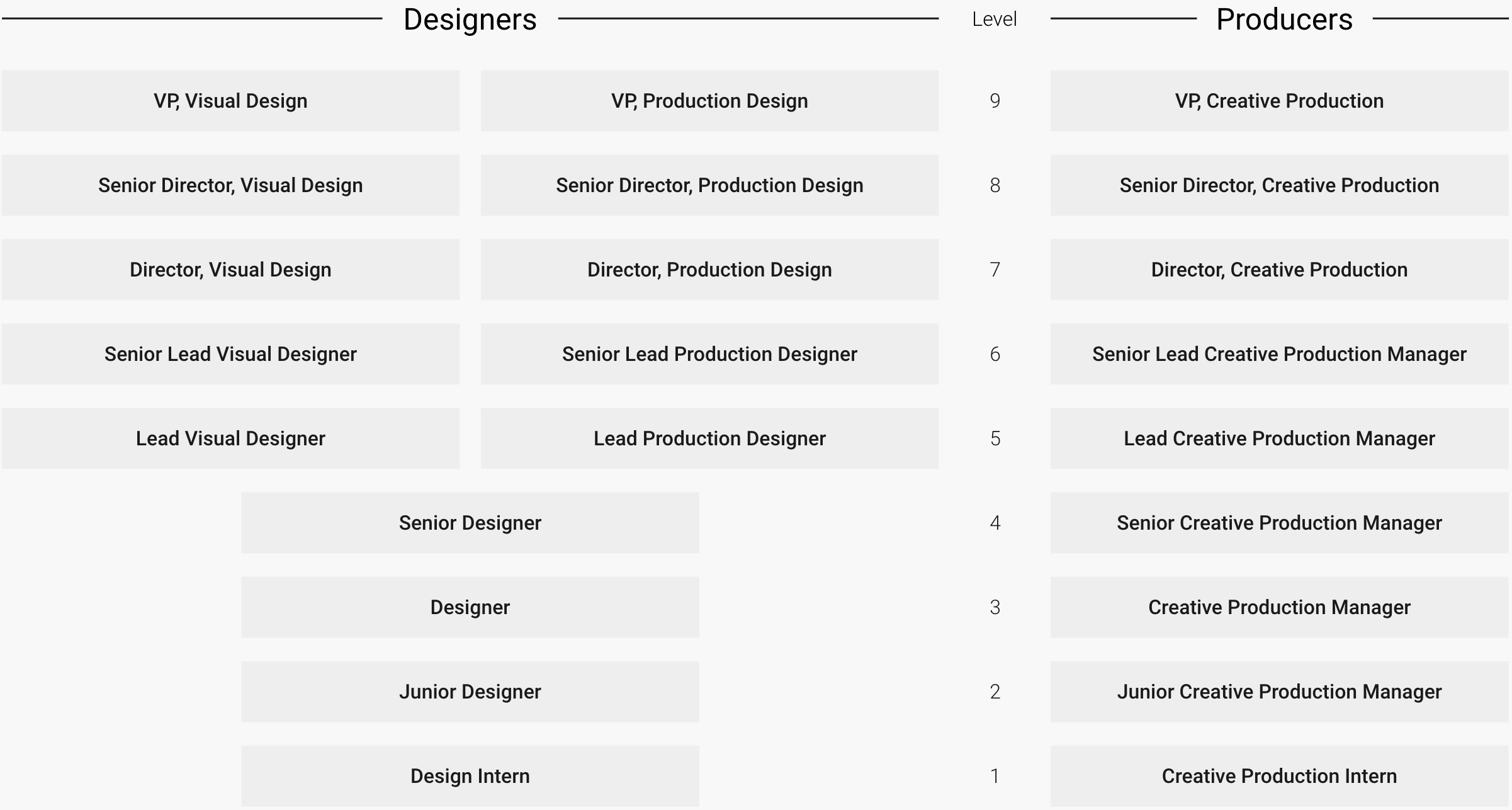
Let’s look at the career ladder and role card I inherited. This company uses a 9-level format within departments, ranging from internship to VP. Executive leadership uses levels 10 through 13 (SVP, EVP, C-level, CEO).
Creative Services Career Ladder (before)
Role Card Structure (before)
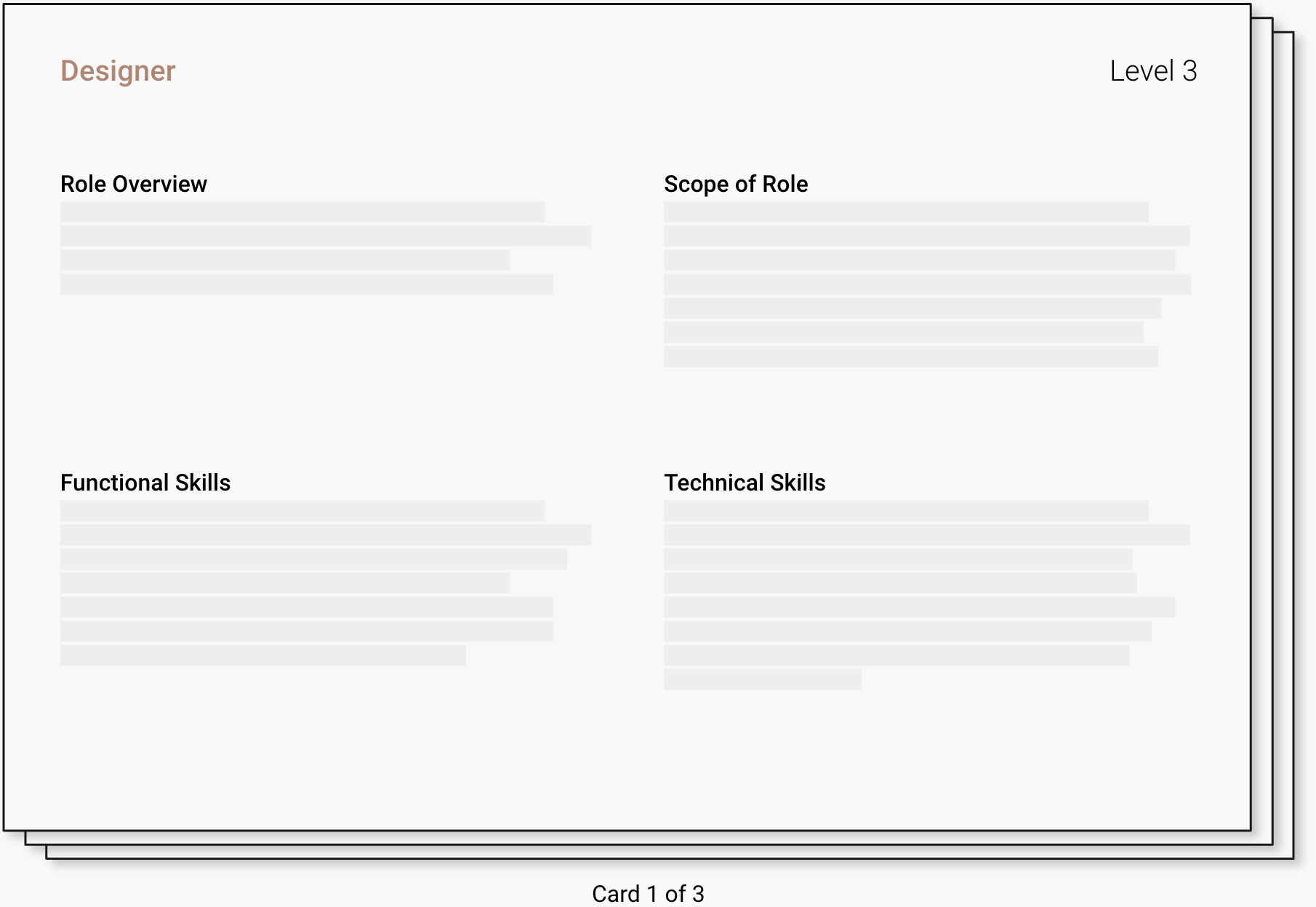
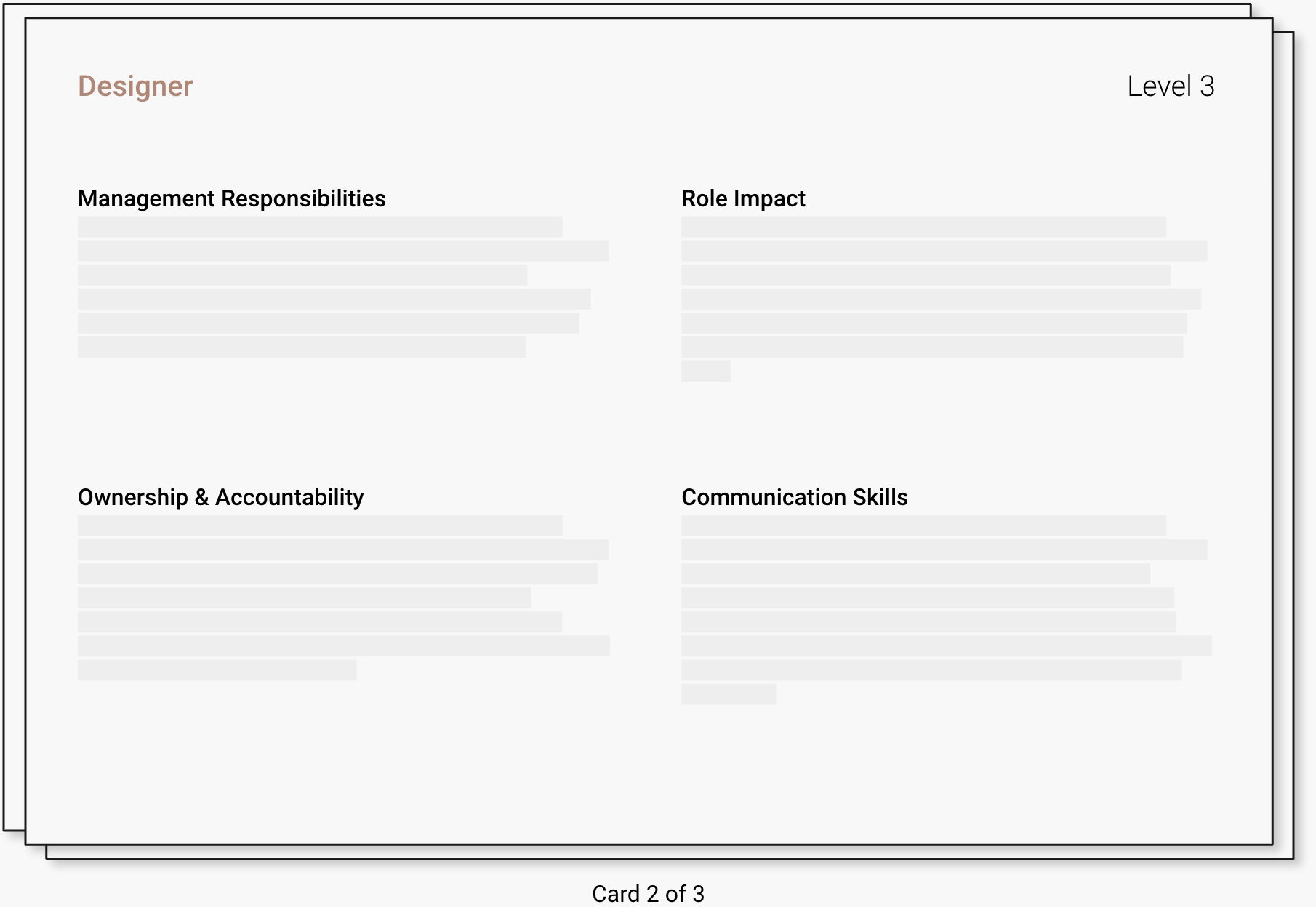
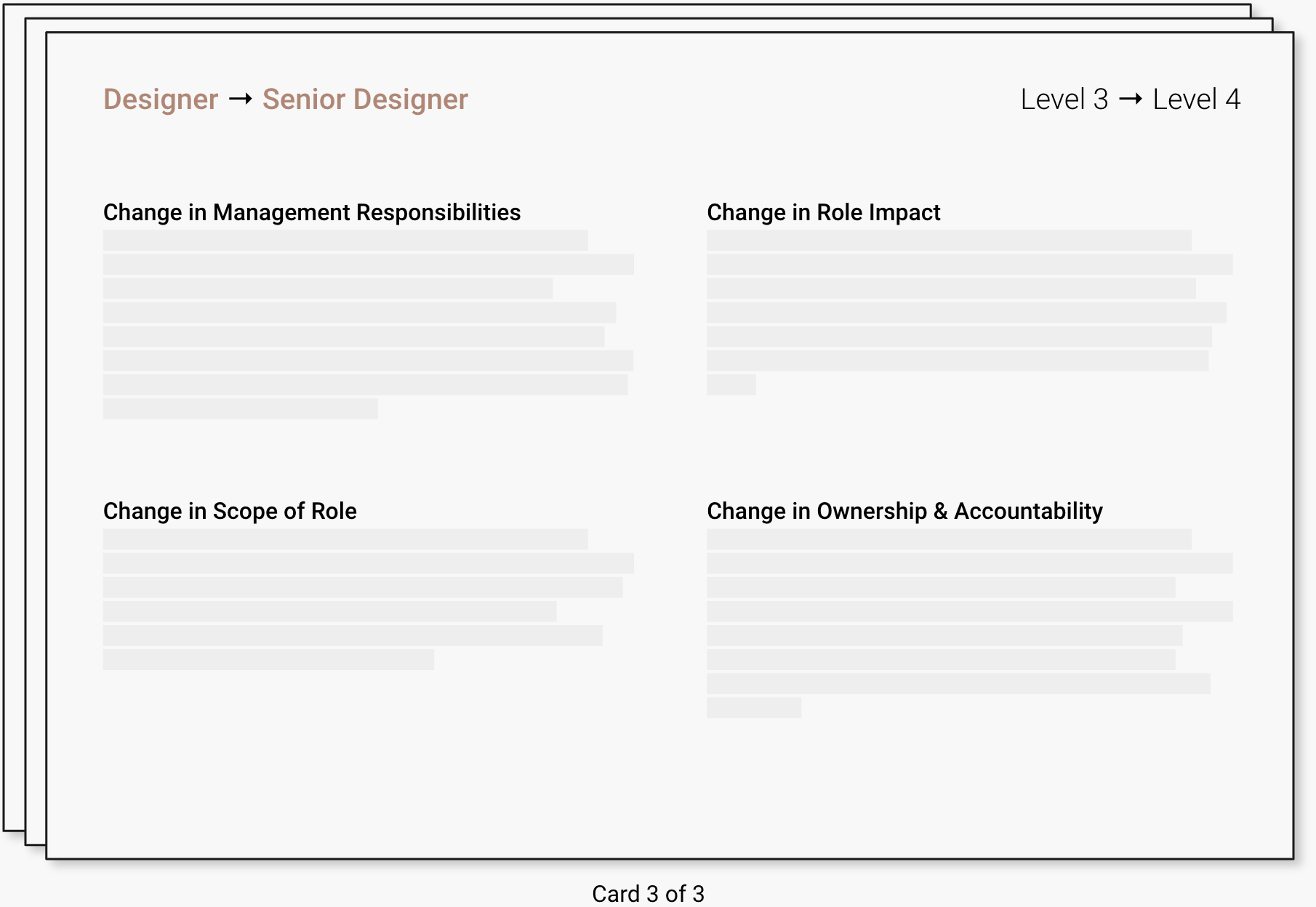
As you can see, my department’s role cards were broken out over 3 cards for each career step. They were written rather vaguely across somewhat overlapping categories.
While this system gave a general understanding of each role, it lacked specificity and examples of what concrete tasks and decision making powers were expected of an employee at a given title.
What I liked about it was the third slide found for each role: a skills gap overview of the expectations an employee had to satisfy before being considered for a promotion to the next level. This would later factor into the inspiration for my overhaul ideas — we’ll get back to those in a little bit.
Observations
23 roles across 69 slides of role cards.
Evaluating career progression requirements is tedious due to information being distributed across multiple slides.
This was a massive deck! Role transition slides (card 3 of 3) were the only way to make comparisons between levels. More in-depth comparison was difficult and required a side-by-side review of multiple slides. Seeing how all roles on the team relate to each other was impossible, as it would require seeing all 69 slides at the same time.
When I inherited department leadership, I set out to overhaul this broken system.
Directors couldn't hire consistently because role definitions varied by team.
Managers had no shared language for performance reviews.
Compensation decisions were inconsistent due to unclear leveling.
Promotion timelines were arbitrary and perceived as unfair.
Tasks
Remove ambiguity, add clarity.
Enable easy comparison of levels.
Incorporate company values and MBO evaluation criteria.
I wanted to create a new career framework that clearly defined the expectations and responsibilities of each role and title in the department. This required more actionable descriptions of expectations. I also wanted to remove perceived ambiguity.
I had to make it easier to compare changing expectations between levels, in order to facilitate more productive leveling discussions between employee and manager.
And I thought it would be nice to incorporate company values and MBO evaluation criteria of the company’s standardized performance review process into the new framework. This had been missing from the previous system, leading to additional confusion.
Actions
Removed Designer track specialization, reducing number of roles from 23 to 18.
Role Cards: from a 69-slides deck to two posters.
A new bottom-up system of qualification modules.
Integration of role cards, company values, and MBO evaluation criteria.
Collaboration with direct reports (Design and Production directors) and HR.
I merged the previously existing specialization for Designers into Visual Design and Production Design, which reduced our overall title count from 23 to 18. This wasn’t done solely for the sake of simplicity, but also had strategic reasons: I needed all designers to be equally skilled with technical and visual design expertise.
I suggested a format change for the role cards. Instead of a slide deck, we would now build two role card posters: one for Designers, another for Producers.
I changed how roles were described. Rather than writing each level’s role card from scratch, we would now build them from the bottom up as a modular system, starting at the intern level (L1), and adding new skill expectations at each level, all the way up to VP level (L9).
I incorporated company values and MBO evaluation criteria by categorizing each roles expectations across 5 core “areas of expertise”. Both Designers and Producers now had the same areas of expertise on their role cards.
Lastly, I collaborated closely with my direct reports and the HR team to meet expectations both from a policy point of view, and to make sure that my team was able to influence a product they would use frequently over the coming years.
Creative Services Career Ladder (after)
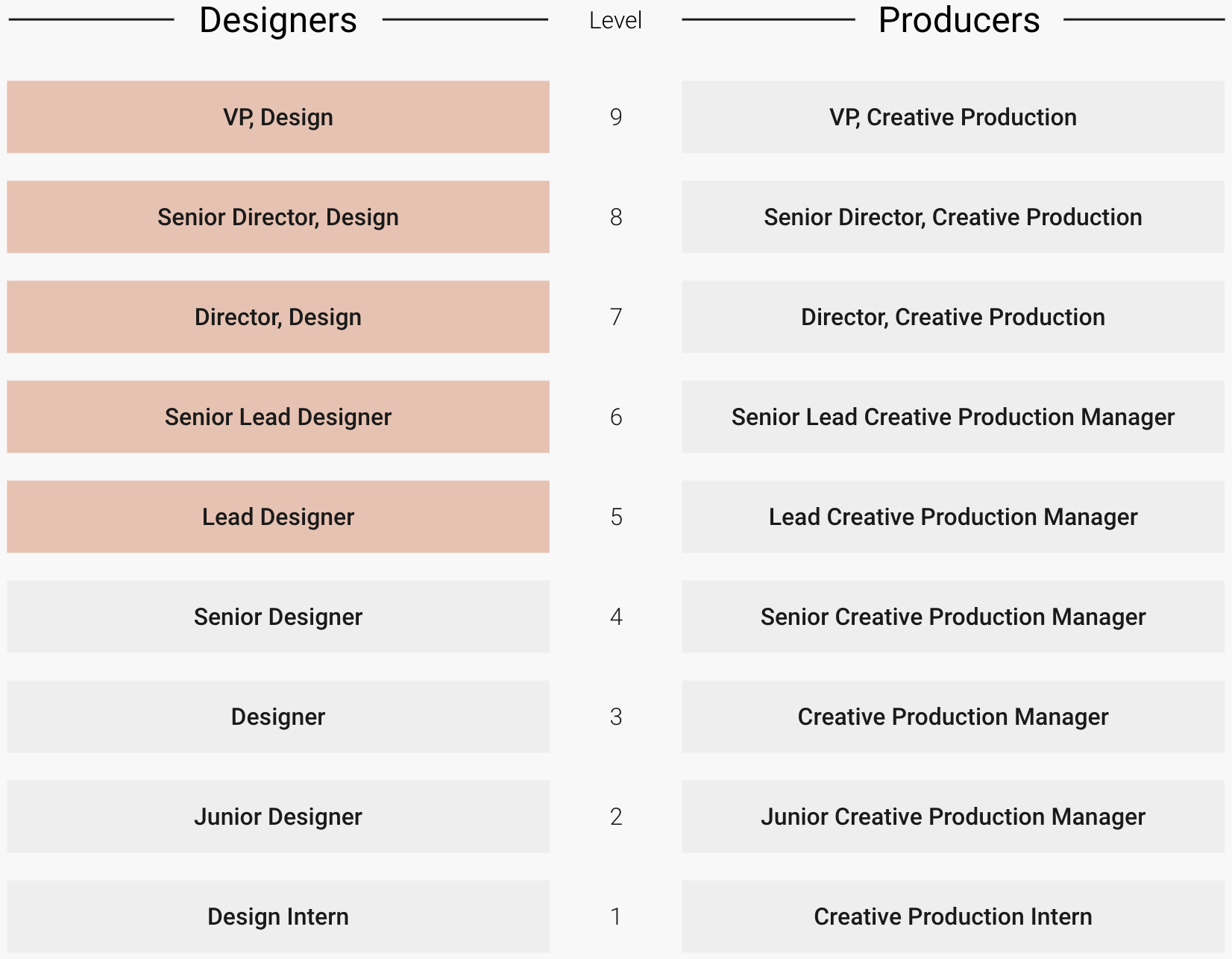
Above is how my department’s career ladders looked like after the simplification. Designers had actually bemoaned the lack of differentiation between “Visual” and “Production” Design, as we had required both tracks to be sufficiently proficient in graphic design skills as well as product feature knowledge. So this change was very much welcomed.
And this is a simplified look at what one of these two new role card posters looked like:
Role Card Structure (after)
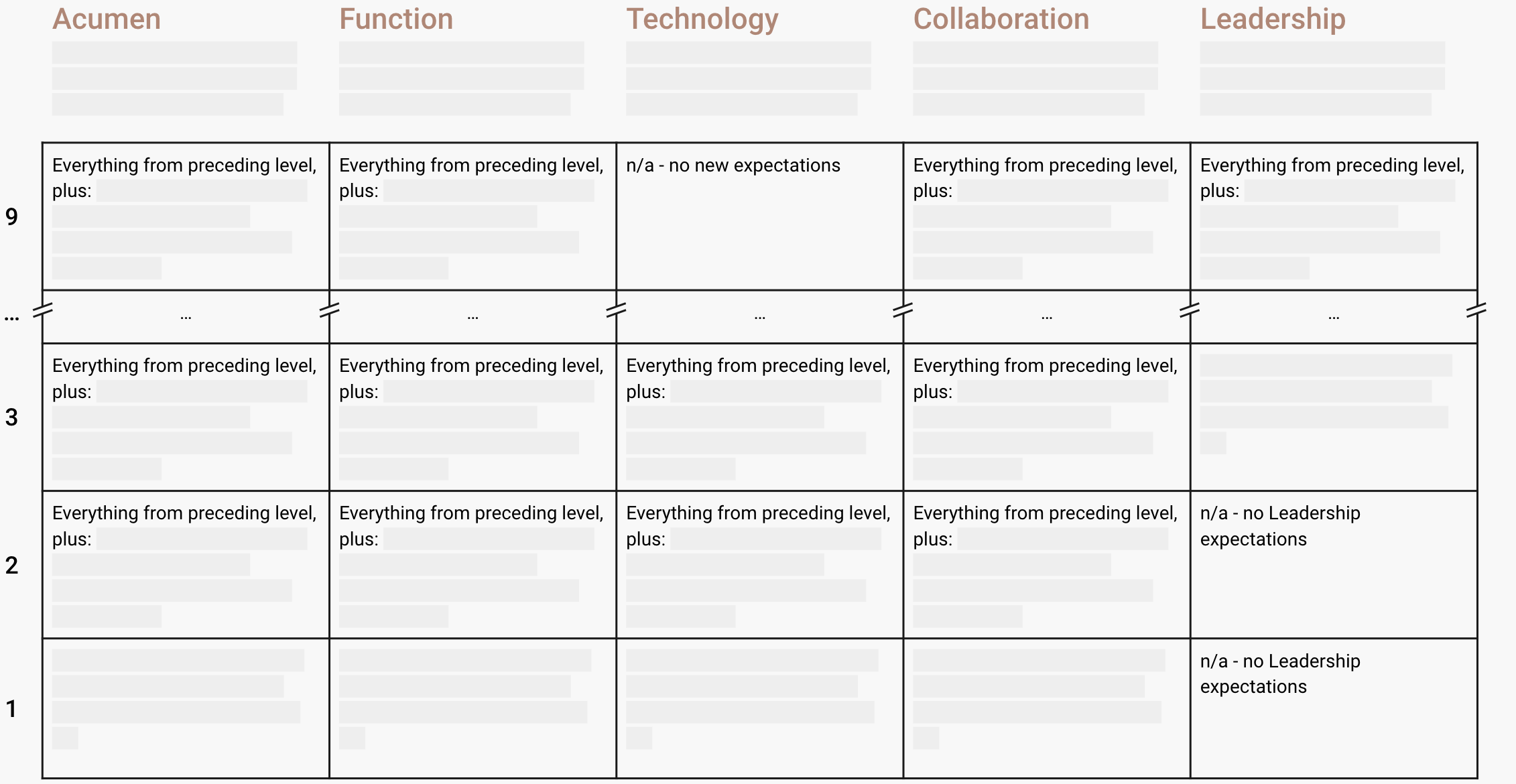
Imagine a table of all 9 levels stacked on top of each other, with columns grouping expectations into 5 areas of expertise. We start at the bottom, describing our expectations for an intern in detail.
As we move up, we define that each higher level inherits the expectations of the preceding level, and we then only describe the newly added additional expectations that come in at the higher level.
This eliminates repetition, and enables the reader to easily understand their expected progression throughout the levels.
Results
Approval by HR and Legal without change requests.
More objectivity in leveling discussions, as expressed via exclusively positive feedback from the department.
Performance goal management 2x more efficient.
Other departments adopted my system.
This new format appeared to be easily understandable, as it was approved by HR and Legal without change requests.
Employees and managers reported being able to now engage in more objective leveling discussions, with an employee’s performance now being easily assessable across all 5 areas of expertise. Employees were now also more readily able to identify areas of growth opportunities.
Time spent by employee and manager to discuss and define quarterly performance goals was cut in half (as measured via timesheets).
I presented the new role card methodology to other department leads, with spun off multiple initiatives to rebuild role cards for those teams in the same format.
I hope case study illustrated my creative problem solving approach to people management challenges. By taking the unconventional approach of ripping and replacing a running system, I demonstrated my willingness to experiment, and believe that it led to a more practical, more logical, more satisfying, and more efficient system.
Download my Role Card template (Google Sheets) ⸱ back to portfolio overview